
Remote Sensing of the Cryosphere:
methods and applications from regional to global scale
06 – 08 February 2023, Bern, Switzerland
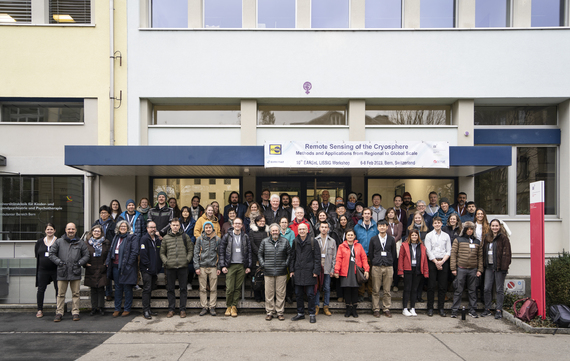
Accessible Files:
Download Complete Workshop Archive
Workshop Overview
With the current anthropogenic warming, the cryosphere is changing. There is a significant retreat and mass loss of glaciers in all mountains of the world. Moreover, Arctic sea ice, seasonal snow cover and permafrost are highly affected by the current and projected climate warming, which may result in significant changes in global atmospheric circulation, as stated by the latest IPCC AR6. Monitoring cryospheric components and their behavior provides not only an effective indicator of climate change, but also allows the effects of these changes on water resources, ecosystems, and socioeconomic processes to be analyzed. Furthermore, remote sensing data are of great benefit for improving and validating climate models.
The workshop focused on the latest developments in remote sensing of land ice and snow. Presentations covered research and applications related to snow and ice as indicators of a changing cryosphere, methods for retrieving cryospheric parameters from various types of remote sensing data, the theoretical basis and application of inversion methods, state-of-the-art retrieval algorithms including deep learning, data assimilation of remote sensing data and in situ observations in process models, and current and planned sensors for snow and ice. Half a day was dedicated to activities from ESA (CCI+) and EUMETSAT.
Papers were presented orally and as posters. The workshop covered the session topics listed below.
Session Topics
- Glaciers and Ice Caps
- Snow cover (regional to global scale)
- Snow and permafrost
- Snow hydrology
- Albedo of the cryosphere
- Cryosphere and climate
- Cryospheric modelling and data assimilation
- Airborne and ground-based observation methods
- New technologies (sensors/methods)
- Educational programs related to ice and snow
- ESA CCI+ snow
- EUMETSAT operational services
Keynote Speakers
- Prof. Dr. Julia Boike (AWI, Germany)
Permafrost and snow dynamic (title TBC)
- Rodica Nitu (Global Cryosphere Watch, WMO)
Global cryosphere watch – status and future plans
- Dr. Carolina Adler (Mountain Research Initiative, Switzerland)
The mountain cryosphere in a changing climate: a view from within science-policy processes
Social Events
- Icebreaker reception (Monday evening)
- Workshop dinner (Tuesday evening)
- Fun run (Tuesday, early morning)
Committees
Scientific Committee
- Prof. Dr. Zuhal Akyurek — Middle East Technical University, Turkey
- Prof. Dr. Julia Boike — AWI, Helmholtz-Center for Polar- and Marine Research, Germany
- Dr. Sari Metsämäki — SYKE, Finland
- Dr. Colleen Mortimer — Environment and Climate Change Canada, Canada
- Dr. Kathrin Nägeli — University of Zurich, Switzerland
- Rodica Nitu — Global Cryosphere Watch; WMO
- Dr. Claudia Notarnicola — EURAC, Italy
- Dr. Céline Portenier — University of Bern, Switzerland
- Dr. Patricia de Rosnay — ECMWF, Int
- Dr. Gabriela Schwaizer — ENVEO, Austria
- Dr. Anna-Maria Trofaier — Climate Office, ESA
- Dr. Helga Weber — University of Bern, Switzerland
- Dr. Clare Webster — University of Oslo, Norway
Organisation Committee
- Dr. Stefan Wunderle — University of Bern, Switzerland
- Dr. Céline Portenier — University of Bern, Switzerland
- Dr. Helga Weber — University of Bern, Switzerland
- Sonia Dupuis — University of Bern, Switzerland
- Elias Frey — University of Bern, Switzerland
- Heide Bierbrauer — EARSeL secretary